High-Sensitivity VOx Core
A 12 µm uncooled FPA at NETD < 15 mK delivers clean thermal contrast in the hardest conditions.
NDAA Compliant · Made In The USA

Cameras
SKU · AAD-CAM-UTIM · 640 VOx core
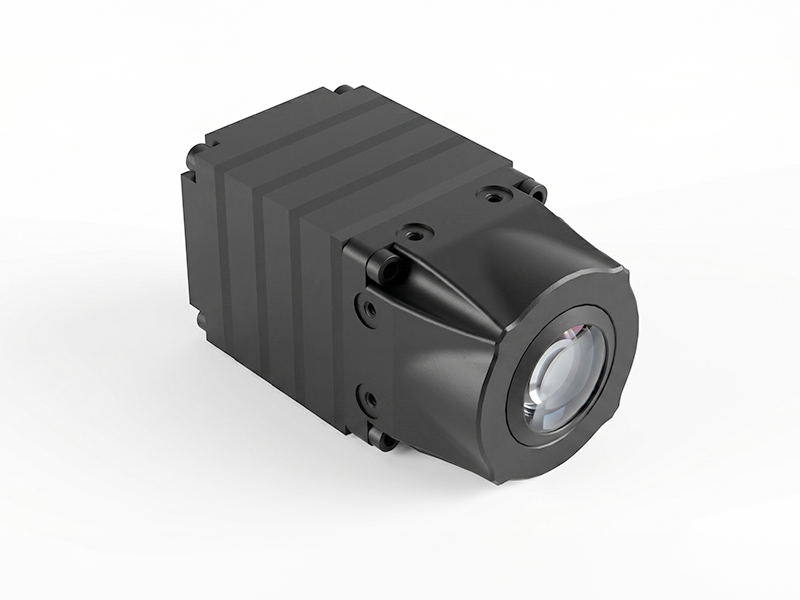
An uncooled LWIR thermal camera that sees through total darkness, smoke and degraded visibility. One camera, two interface variants — digital Ethernet for onboard AI, or analog CVBS plus digital USB UVC for legacy FPV chains — on a 640×480 VOx core, with interchangeable Germanium optics.
Digital Ethernet · UTIM-D
UDP/RTSP H.264/H.265 · <50 ms
Analog + USB · UTIM-A
CVBS analog + USB UVC · 30 ms
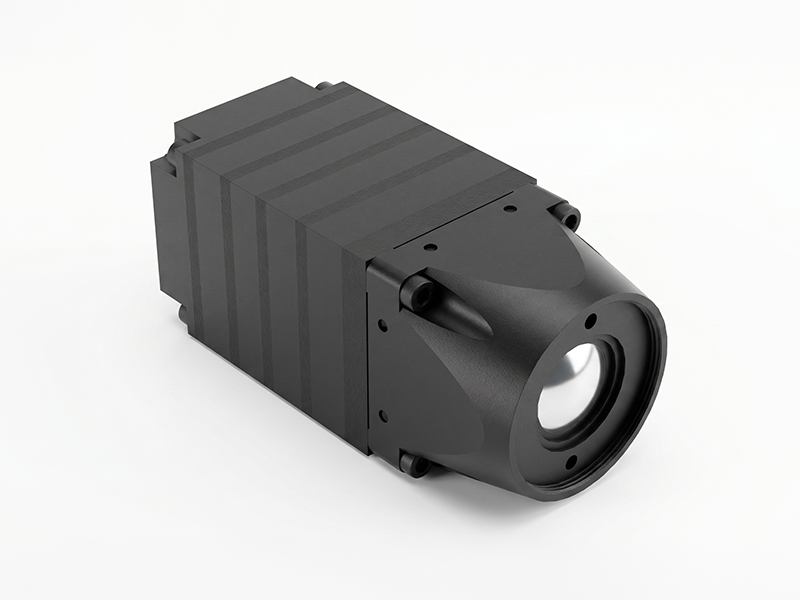
A high-sensitivity 12 µm VOx core (NETD < 15 mK) for detection in complete darkness, smoke and degraded visibility — clean thermal frames built to be read by an onboard detection model, with a choice of 9 mm or 25 mm optics.
Core specs and the features that make UTIM the all-conditions thermal eye of the AAD targeting stack.
A 12 µm uncooled FPA at NETD < 15 mK delivers clean thermal contrast in the hardest conditions.

Detection in total darkness, smoke, fog and degraded visibility — day or night, no illumination required.

Digital Ethernet (UTIM-D) for onboard AI, or analog CVBS plus USB UVC (UTIM-A) for legacy FPV chains.

9 mm wide or 25 mm long-range Germanium lenses, matched to the mission profile.
Two field-swappable Germanium lenses on the same 640×480 core. Field of view is the trade-off — a wider lens keeps more of the scene in frame, a longer lens magnifies distant heat signatures so the model detects and identifies them sooner.
Wide · 46° × 35°
The all-round default — broad situational awareness for mid-range strike, FPV and ISR, keeping the target in frame through aggressive terminal maneuvers.
Narrow · 17.5° × 13°
Long-range observation and stand-off detection — the tighter field magnifies distant heat signatures for earlier detection and identification.
Both lenses mount on the same 640×480 · 12 µm core and share the fixed-infinity, deploy-and-go setup. FOV figures are computed for that detector.
A heat signature the AI can't resolve is a target it can't engage — so we don't cut corners on the glass.
Most low-cost thermal lenses are only sharp in the center of the frame. Toward the edges the thermal image softens, and detection models start to miss or misclassify heat signatures that drift away from the middle of the picture.
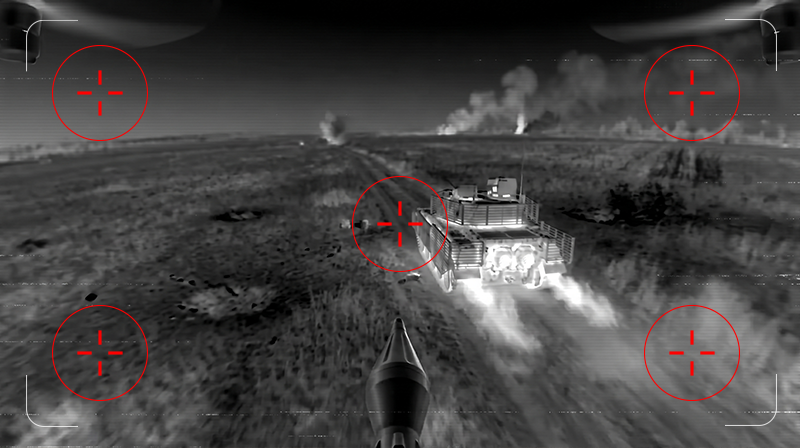
Every signature locked — corners and center.
UTIM uses a high-quality Germanium lens that holds a uniform, sharp thermal image across the entire frame. Targets are detected and identified just as reliably at the edges as they are dead-center — which matters most in the seconds before a target leaves the field of view.
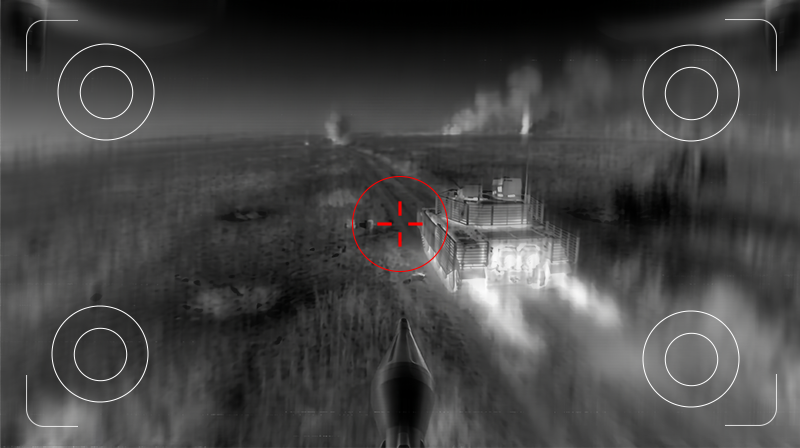
Edges soften — targets missed at the corners.
Shared thermal-core specs, with interface-specific notes for the two output variants — digital Ethernet (UTIM-D) and analog CVBS (UTIM-A).
| Detector | 12 µm VOx uncooled FPA |
|---|---|
| Resolution | 640 × 480 |
| Pixel pitch | 12 µm |
| NETD | < 15 mK |
| Frame rate | 60 / 30 fps (digital) · 25 fps (analog) |
| Imaging | WDR + detail enhancement |
| Optics | 9 mm F/1.2 · 25 mm F/1.0 (Ge) |
| Interface | Digital Ethernet or Analog CVBS |
| Latency | < 50 ms (Ethernet) · 30 ms (analog) |
| Operating temp. | −30 … +55 °C |
| Dimensions | 21 × 21 × 46 mm · 50 g |
| Adjustable | Video & image parameters available for tuning — can be applied live, in flight (Ethernet) |
A thermal sensor for the missions daylight can't reach — night, smoke and degraded visibility, across strike and ISR platforms.

Night & low-visibility strike

Thermal observation & ID

Heat signatures vs cold sky
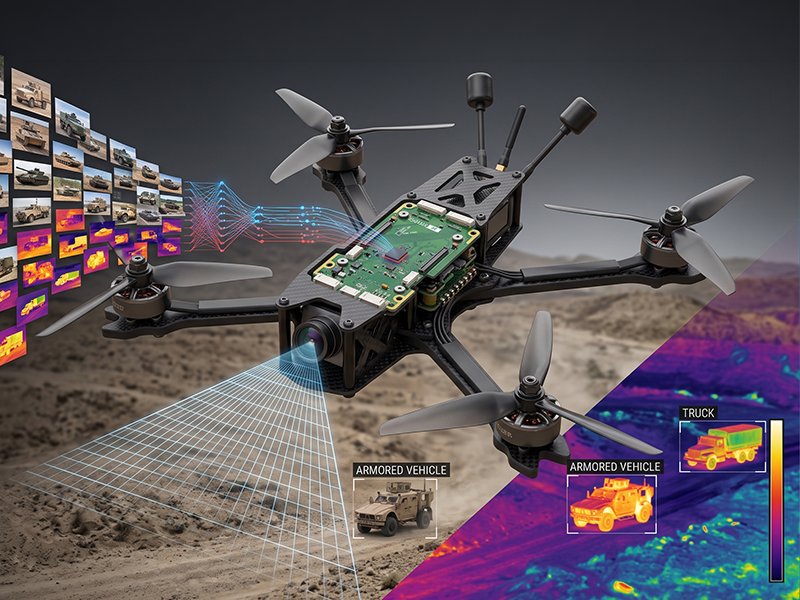
UTIM isn't a thermal camera that happens to feed an AI — it's built for ours. Wield-AI runs detection and identification on the live thermal video, drawing a box and a confidence score around every heat signature the model recognises.
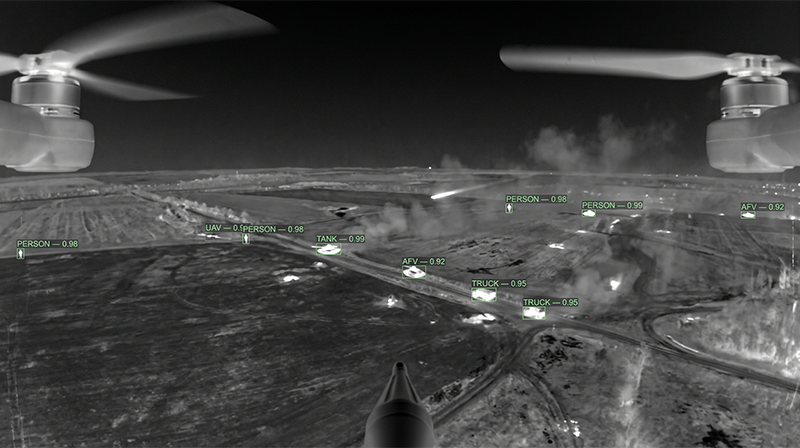
We can provide a representative thermal dataset — and a fully trained model — so you can validate detection and identification before you commit.
We set the thermal tonemapping, NUC and palette ourselves, calibrated to the conditions our models are trained on — not a generic factory profile.
Because we build both, sensor output and model expectations line up — stronger detection and fewer missed targets out of the box.
Technical Documentation
Wiring diagrams, CAN and CSI pinouts, power rails, expansion options, and step-by-step setup — everything on UTIM lives in our Knowledge Base.
Learn More in Our Knowledge Base →Built to work as one system — camera, compute and AI on a single stack.